


If the Experts Need 974 Patches, What Chance Does Your Child Have?


Authored by: Patrick SchoutensCTO, Dev Architect, Autonomos AI.

The Question We Are Not Asking

In my previous article, AI Didn’t Create 974 Vulnerabilities. It Found Them, I questioned what it says about our software industry when a single patch cycle can expose close to a thousand vulnerabilities in products used across governments, businesses, schools and homes around the world.

But there is a much bigger issue here, and it has almost nothing to do with the cybersecurity industry.

It is about the rest of us.

If highly sophisticated enterprises, governments, security teams and technology companies require enormous security budgets, specialist personnel, threat intelligence, vulnerability-management systems and a continuous stream of patches simply to keep their environments reasonably secure, what realistic chance does the ordinary person have?

If highly sophisticated enterprises, governments, security teams and technology companies require enormous security budgets, specialist personnel, threat intelligence, vulnerability-management systems and a continuous stream of patches simply to keep their environments reasonably secure, what realistic chance does the ordinary person have?

What chance does a teenager have?

What chance does an elderly person living alone have?

What chance does a parent have who simply bought a computer for the family, connected it to the internet and reasonably assumed that the companies behind the operating system, browser, applications and online services had made those products safe enough to use?

That, I believe, is the conversation we are not having loudly enough.

[/vc_column_text]

AI control Layer
[/vc_column][/vc_row]

We have spent years telling people to:

• Use stronger passwords

• Turn on multifactor authentication

• Avoid suspicious links

• Keep software updated

• Recognise phishing

• Distrust unexpected messages

• Check URLs

• Protect their identities

• Somehow distinguish legitimate communications from increasingly sophisticated fakes.


Those are sensible precautions, but at some point we need to ask whether we have quietly transferred far too much responsibility for digital security from the companies that design, manufacture and operate these systems to the people least equipped to defend them.

AI Teen Protection
  • A teenager should not need to understand vulnerability management to use a computer safely.
  • A grandmother should not need to understand identity compromise before she can safely respond to what appears to be an email from her bank.
  • A child should not need to recognise synthetic voices, deepfake video, credential theft, malicious links, impersonation and social engineering before being allowed to participate in the digital world.

Yet increasingly, that is the environment we are giving them.

This is not an abstract concern. According to the FBI’s 2025 Internet Crime Report, Americans over the age of 60 reported more than $7.7 billion in losses from internet-enabled crime in a single year. People under 20 reported more than 31,000 complaints and over $67 million in losses.

The Federal Trade Commission separately reported that scams beginning on social media produced approximately $2.1 billion in reported consumer losses during 2025, affecting people across virtually every age group.

Those are reported losses. The real human impact extends well beyond the numbers.

This is no longer something happening only to careless people wandering through obscure corners of the internet. It is happening inside the mainstream digital environment in which we have placed our families, our finances, our identities and increasingly our lives.


Artificial Intelligence Raises the Stakes

Artificial intelligence is now raising the stakes again.


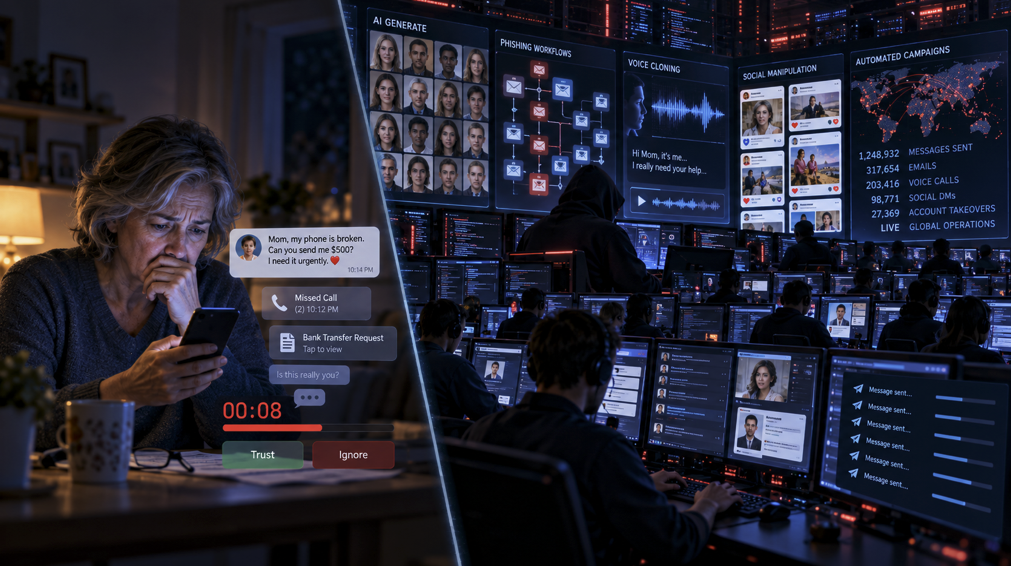
AI can help criminals produce persuasive communications in almost flawless language, imitate voices, create synthetic photographs and video, construct fake identities, automate conversations and conduct fraud at a scale that previously required enormous human effort. The technical and linguistic barriers that once limited many forms of fraud are disappearing.


We therefore have an extraordinary imbalance developing.


On one side may be a child, an elderly person, a busy parent or an ordinary employee who has perhaps seconds to decide whether something appearing on a screen, arriving in an inbox or speaking through a telephone is genuine.

On the other side may be automated infrastructure, stolen personal information, professional criminal organisations, artificial intelligence, synthetic identities and systems capable of attempting the same attack against thousands or millions of people simultaneously.

That is not a fair contest.

And simply telling people to become more “cyber aware” is no longer an adequate answer.

The Weakest Path Is Enough

There is an important technical distinction that needs to be made here. Not every scam begins with an operating-system vulnerability.

Not every stolen identity results from an unpatched computer.

Social engineering frequently attacks the person rather than the software, and many attacks begin through credentials, applications, communications platforms or compromised accounts rather than an underlying operating system.

But separating these problems too neatly misses the much larger point.

The attacker does not care which component of the digital environment fails.

• A software vulnerability may provide an entry point.

• A compromised account may provide identity.

• A stolen session may provide access.

• A manipulated person may provide credentials.

• A malicious application may provide persistence.

• Social media may provide information about the victim.

• Artificial intelligence may provide the persuasion.

The criminal simply searches for the weakest available path.

Security professionals may classify all of those as different attack vectors. For the person on the receiving end, the distinction is largely academic.

Someone got through.

Beyond Patch Tuesday

That is why the extraordinary number of vulnerabilities being discovered inside the foundations of our digital environment matters far beyond Patch Tuesday.

A vulnerability is not merely a technical defect sitting quietly inside a CVE database. Under the right circumstances, it can become one part of an attack chain that eventually reaches a real human being.

Behind that screen may be a pensioner. Behind that account may be a teenager. Behind that identity may be somebody’s child.

We therefore need to be extremely careful about normalising a model in which the answer is simply another patch.

Patching is essential. Of course it is. When a vulnerability is discovered it must be fixed, and it must be fixed quickly.

But patching is remediation after weakness has already entered the ecosystem.

There is an enormous difference between saying, “We discovered this problem and fixed it quickly,” and building a digital world in which the number and complexity of problems have become so great that continuous remediation is accepted as the permanent natural condition of computing.

A multinational organisation with a security operations centre may be able to manage that reality.

Somebody’s home cannot.

Ordinary people do not have vulnerability-management teams, threat-intelligence feeds, security architects or analysts investigating anomalous behaviour in the middle of the night. They have a laptop, a phone, perhaps a tablet, an internet connection and an entirely reasonable assumption that the technology they purchased is fundamentally safe.

That assumption matters because digital technology is no longer optional infrastructure.

  • Children learn through it.
  • Families communicate through it.
  • People bank through it.
  • Older people manage pensions and savings through it. Medical information travels through it.
  • Governments provide services through it.
  • Our photographs, identities, relationships, finances, locations and conversations increasingly exist inside it.

We would never knowingly design physical public infrastructure on the assumption that every citizen must become a structural engineer in order to remain safe.

Yet in digital infrastructure, we repeatedly place the final line of defence on the individual.

We tell the user not to click, not to trust, to update everything, to recognise the fake and to notice when something does not look quite right. Then, when an attack succeeds, there is often an unspoken suggestion that the victim should somehow have known better.

I believe we need to reverse that thinking.

Stop Designing for Perfect Users

The ordinary person should be the last person we expect to compensate for insecure architecture.

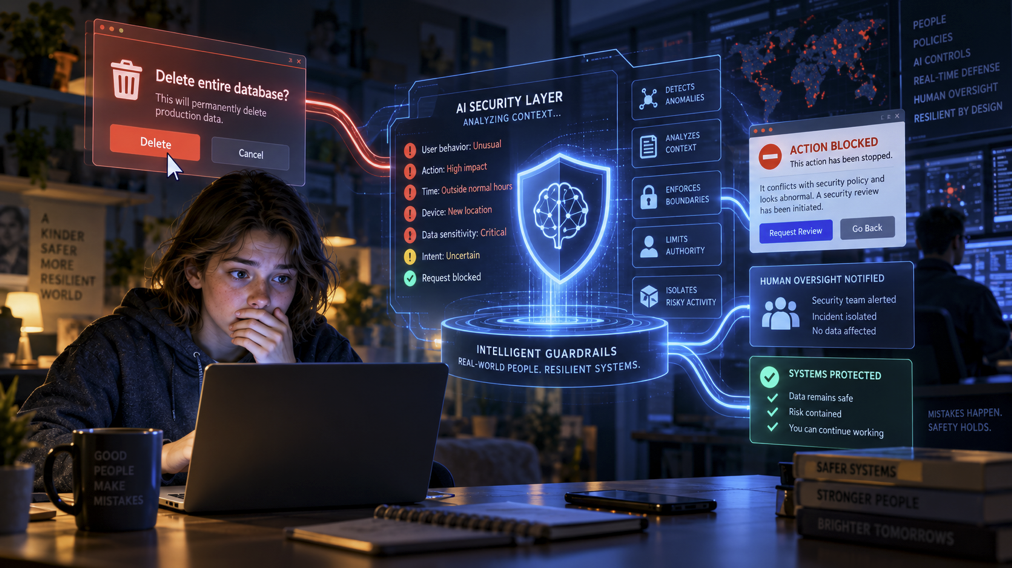
Security needs to move toward systems that assume human beings will occasionally make mistakes, because human beings always have and always will. A child will eventually click the wrong thing. An elderly person may trust somebody who sounds completely convincing. A tired employee will eventually open the wrong attachment. Somebody will reuse a password. Somebody will believe a voice on the telephone because it sounds exactly like their son or daughter.

In the age of artificial intelligence, even intelligent, cautious and technically competent people are going to be deceived.

The objective therefore cannot be to manufacture perfect users.

The objective has to be to build digital environments that remain resilient when imperfect human beings use them.

That requires a fundamentally different philosophy.

Technology should increasingly be capable of:

• Understanding context

• Recognising abnormal behaviour

• Detecting when identity and behaviour no longer correspond

• Questioning consequential actions

• Limiting authority

• Isolating suspicious activity

• Intervening before one human mistake becomes a financial, personal or organisational catastrophe.

AI as Part of the Solution

This is where artificial intelligence can become part of the solution rather than simply another source of risk.

The same technology that allows attackers to operate at machine speed can allow defenders to operate at machine speed. But intelligence alone is not enough. An AI system capable of observing everything and acting without meaningful control simply creates another form of risk.

What we need are intelligent systems in which observation, detection, reasoning, decision and action are governed; where authority is explicit, contextual and bounded; where consequential actions can be challenged, contained or denied; where evidence is preserved; and where control remains with the organisation or individual rather than disappearing into an opaque technological system.

And that brings this discussion to something much larger than cybersecurity.

From Cybersecurity to Digital Sovereignty

From Cybersecurity to Digital Sovereignty

It brings us to Digital Sovereignty.


Digital Sovereignty is increasingly becoming a strategic issue internationally because governments are recognising that genuine sovereignty in the modern world requires meaningful control over critical digital infrastructure, technology, data and the decisions that depend upon them. Dependence on a small number of external providers for operating systems, cloud computing, artificial intelligence, identity systems, communications and other critical digital infrastructure is no longer merely a commercial question. It is becoming a question of autonomy, resilience, jurisdiction and control.

The same principle applies at the organisational level, and ultimately it has consequences for the individual.

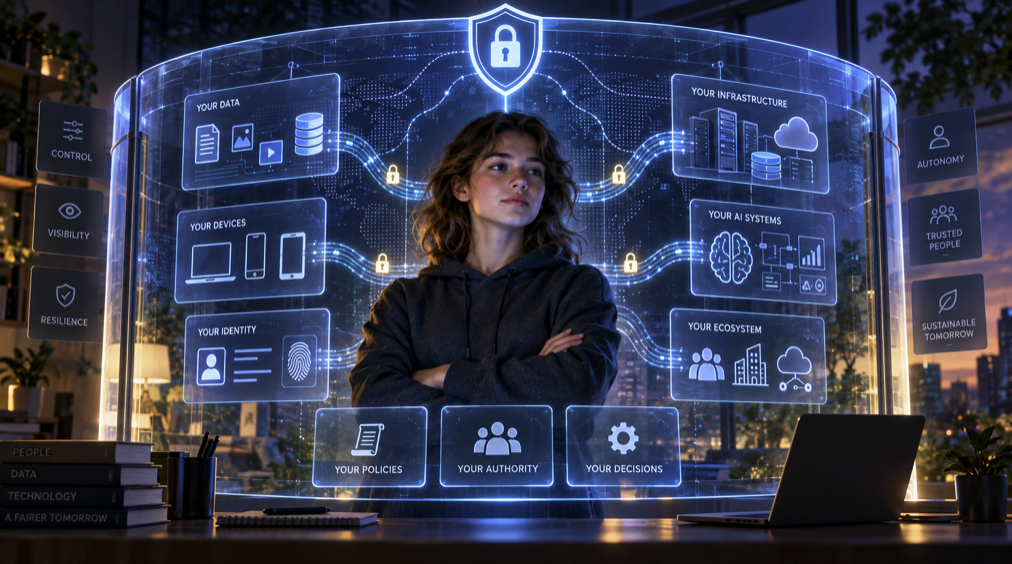
At Autonomos AI, when we speak about Digital Sovereignty, we mean retaining meaningful control of your digital environment:

• Control of your infrastructure

• Control of your data

• Control of your intelligence

• Control of your identity and access

• Control of policy

• Control of authority

• Critically, control over which machines are permitted to make which decisions and take which actions.

It does not mean disconnecting from the world. It does not mean rejecting cloud computing, global technology or artificial intelligence. Sovereignty is not isolation.

It means that dependence should not become helplessness.

An organisation cannot realistically claim digital sovereignty if it does not know where its critical data is being processed, who can access it, which systems can act upon it, under whose authority those actions occur, which external dependencies can disable its operations, what jurisdiction governs those dependencies or whether it can continue functioning when an external provider changes the rules.

And ordinary citizens experience the consequences of those same dependencies whether they ever use the words “Digital Sovereignty” or not.

When your identity, financial life, communications, photographs, personal information and access to essential services increasingly depend upon digital systems over which you have almost no visibility or meaningful control, security stops being merely a technical question.


It becomes a question of sovereignty.

A child cannot meaningfully exercise digital sovereignty if the environments through which that child learns, communicates and develops relationships are fundamentally opaque and the burden of recognising danger falls primarily on the child.

An elderly person cannot meaningfully exercise digital sovereignty if access to savings, identity and essential services depends on being personally capable of distinguishing a sophisticated synthetic fraud from a legitimate communication.

And an organisation cannot meaningfully claim Digital Sovereignty merely because it legally owns its data while the infrastructure, intelligence, identity, decision-making and operational authority surrounding that data remain outside its effective control.

That is the direction in which this conversation needs to move.

Who Ultimately Controls the Digital Environment?

Cybersecurity is an essential component of Digital Sovereignty, but Digital Sovereignty is bigger than cybersecurity.

It is about who ultimately controls the digital environment.

• Who owns the data.

• Who controls the infrastructure.

• Who controls identity.

• Who defines policy.

• Who holds authority.

• Who can make decisions.

• Who can take action.

• Who can revoke that authority.

• Who retains the evidence.

• Who determines the jurisdiction.

• Whether the human being, organisation or nation remains in command of the technology on which it depends.


What the Next Generation of Security Must Do

This is precisely why the security of the underlying operating systems and platforms matters so much.

If the world’s most sophisticated technology organisations require extraordinary resources and continuous remediation to secure the foundations of the digital ecosystem, then we cannot reasonably place the final responsibility for surviving that ecosystem on a child, a pensioner or an unsuspecting member of the public.

The next generation of cybersecurity therefore cannot simply become better at warning people that danger exists.

It has to become better at standing between people and that danger, while returning meaningful control of the digital environment to the people and organisations whose lives and businesses depend upon it.

Because ultimately this is no longer only a cybersecurity problem.

• It is a consumer-safety problem.

• It is a child-safety problem.

• It is an elder-safety problem.

• It is an infrastructure problem.

• It is an autonomy problem.

And, increasingly, it is a Digital Sovereignty problem.

The Bigger Question

The question we should be asking is no longer merely whether our technology can protect us from the next attack.

The bigger question is whether we still meaningfully control the technology on which our lives now depend.

Autonomos AI

Autonomous Intelligence, Decision & Control

Building Digital Sovereignty.

#DigitalSovereignty #CyberSecurity #ArtificialIntelligence #DigitalSafety #ChildSafety #ElderSafety #ConsumerProtection #AgenticAI #AISecurity #DigitalInfrastructure #AutonomousSecurity #AutonomosAI